I believe that information is our most powerful tool in just about every instance. Be aware of what you're dealing with, be aware of what can happen, know what you want, and know how to voice it. You are your biggest advocate in all things self, and you are the advocate for your children until they an do it themselves. Be informed, and use your voice.
Showing posts with label booster seat. Show all posts

Thursday, September 1, 2011

Car Seat Usage 101


Car seat safety is one of the most important things you can do for your child.  The most common killer of small children is car accidents.  Having your child in a correct seat, facing the correct direction, with everything else exactly right doesn't guarantee nothing horrible will happen, but it DOES drastically, enormously, raise the chance of a happy outcome.  Here are some of the basics to consider, and why.

The first thing you should do when you buy a seat is READ THE MANUAL.  It contains a wealth of useful and necessary information about the seat you are entrusting your child's life to. 

There's a lot of information, and a lot of points to remember.  You should see how long it's taken me to write this blog entry, and how many revisions I had to make because I forgot something.  Seriously.

If you think you have everything right as is, you should take your seat to a CPST (Child Passenger Safety Technician).  Fire houses and police stations won't really cut it, since they aren't required to know a single thing about car seats or car seat safety beyond "kids should be in one."  A CPST is the best choice by far if there's one in your area.


Correct Seat Installation.
1) the seat should be installed with the "this line level to the ground" line... well, level to the ground.   30-45 degree angle, depending on child's age (see below).  The following link will help you determine if your seat is at the proper incline: Check My Recline Angle!
2) You can use LATCH *or* the safety belt, but you aren't supposed to use both.  Use whichever one gets a better install with your seat and your vehicle.  In most cars, LATCH can't be used in the middle seat, and you shouldn't share LATCH anchors.
3) It doesn't matter so much where you position the seat (middle or outbound, back row or middle row), as long as it's in the back seat with a good install.  The middle is safest, but the outbound seats aren't unsafe.  Generally you want to put the "least safe" kid in the middle.  So booster (assuming it's a lap and shoulder belt) --> forward facing --> rear facing.
4) It's okay for the seat to tilt in one direction or the other, as long as it's less than 20 degrees.  More tilt than that and you should use a locking clip or LATCH, rather than the safety belt.  The seat should only be able to move one inch along the belt path.
5) Top tether all forward facing seats.  That tether can reduce forward motion of the child's head by 8 or more inches, depending on the child and the crash.  Some models offer a tether for rear facing seats as well.  If your seat has a tether, use it. Tethers can't share anchors.

Other things you should know:
** Car seats expire.  Besides the fact that newer and better (read: safer) seats are constantly being produced, car seat materials deteriorate over time.  Even though your seat may LOOK fine, there's no way to tell if there is structural damage on the inside of the shell.  Most seats expire after 6-10 years from the day they were made (NOT the day you bought them).  Check your manual for your seat's manufacture date and when it expires.  Never use an expired seat, as it could be unsafe.
** The harness material can't be soaked.  Wiped down sure, but not soaked.
** In the unfortunate case of an accident, a car seat should be replaced, even if no child was in it during the crash.  There may be unseen damage to the seat from the forces of the crash, and it's just best to replace it.  Most insurance companies will cover the cost of a new, comparably priced, car seat.
**You shouldn't buy or use a used seat unless you know exactly where it came from.  If you know for sure that it's never been in an accident, that's it not expired, and that it's never been soaked, then you're probably okay.  But Craigslist, Thrift stores, and Free Cycle are never good places to get a car seat.  If you can't afford a car seat for your new baby, I do believe you can procure one for free from a fire house or police station.  Look into that option in your area before you buy a used seat!
** Always Check Before You Leave.  You may notice in some of the below "misuse pictures" we are on the road.  It's important to check the chest clip, the seat install, the strap tightness, and everything else I mention before you leave the driveway or parking spot.  But it's also important to glance into the back seat and check periodically during the drive.  My own child has a tendency to move his chest slip around, and sometimes he reaches down and unbuckles the seat belt keeping his seat installed.  He can also unbuckle the crotch part of his car seat, then when he rebuckles it the straps are twisted.  In the cases below, I had to pull over and fix his straps or his chest clip, but I took a picture of it before doing so, for the sake of example.  If you notice your child has screwed something up while you're driving, pull over.  You'd pull over if you noticed your trunk was open, or that your tire was thumping.  Pull over if you notice your child isn't being safe.

Proper incline for newborns. 
A seat with a newborn should be at a 45 degree angle.  Because the child cannot effectively support his/her own head, a seat that's not properly reclined yields to the risk of suffocation if the baby's chin falls to her chest, closing the airway.  To help a convertible seat recline to the proper angle, you can use one pool noodle cut into three pieces and taped into a pyramid shape.

Rear face as long as possible.  The AAP now recommends that children remain rear facing in a seat until at least the age of 2, but preferably until the child outgrows the rear facing limit of the seat.  The law in most states is one year AND 20 pounds, but being 12 months and weighing 20 pounds is simply not enough, safety wise.  Before the age of two, the skull and spinal column are not completely fused together.  Think of the uncomfortable head/neck positions we see our babies sleeping in and say "how can that possibly be comfortable?!" It's because their bodies are not completely put together like ours are.  What we call "whiplash" is what happens to a small toddler when they are forward facing.  The difference is that, without the proper amount of development, the tissue connecting the head and neck severs more easily.  This is called "internal decapitation" and it is usually fatal.  Children is a rear facing seat are 500% safer than forward facing.  There are seats on the market that rear face to 40 and even 45 pounds.  An older rear facing child learns to sit in a comfortable position, and there have never been reports of a broken leg because they touch the back of the seat.  But, even if breaking a leg was a concern, the alternative is breaking a neck.  Which would you choose?

Harness as long as possible.  A child should be harnessed as long as possible, but at least to the age of 5 or 6.  Most states allow booster seats at 4 or even younger, but the average child is not emotionally ready for a booster seat at that age.  They need to be able to still still, not fall asleep, not lean forward, not lean to the side... if they are out of alignment when an accident occurs, they could easily be injured.

Think about a race car driver, and the seat belts they use.  They are harnessed into their seats as tight as possible, right? For their own safety? Yes, they are traveling at VERY high speeds, much higher than what we travel in traffic, but if harnesses are safer at very high speeds, they are safer at lower speeds.  There are seats on the market that harness to 65 or even 85 pounds.


Strap tightness.  The straps on the seat should pass the pinch test: if you try to pinch the material of the strap between your thumb and index finger, it should be tight enough that your fingers slide off, rather than actually being able to pinch it.  If your child's straps look like Heidi's, they are way too loose.

The danger of loose straps should be obvious - at best your child becomes a projectile within their own seat.  Instead of the straps pinning them against the back of a seat, your kiddo will fly forward into the straps at the same force as the collision.  Think what would happen if your own seat belt didn't lock quickly when you hit the brakes.


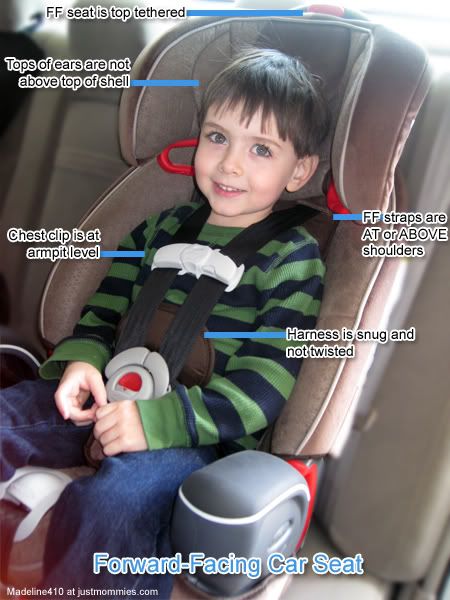
Along with strap tightness goes strap position.  The straps of a rear facing seat should be below or in line with the shoulders, and the straps of a forward facing seat should be above or in line with the shoulders.  Straps that are too low could cause spinal compression during an accident, and straps that are too high may not hold your child in securely.

Another point is that the straps shouldn't be twisted, as this can reduce their functionality, and make them feel tighter than they really are.  If a strap or two is twisted, your baby may not be as safe as you think.

In the picture of Luke (above left), the right side strap is twisted and his chest clip is too high.  And notice that, even though he is nearly four, he is still in a harnessed seat.  Since he still moves his chest clip around, and even takes it off, he's simply not ready for a booster, as most kids his age aren't.  Just wanted to mention that while I had the picture in sight. ;)

Chest clip.  This seems to be the most easily ignored factor for parents, but it's still important.  It's called a CHEST clip - not a neck clip, or a stomach clip.  It goes between armpit and nipple level.  If the chest clip is incorrectly placed, then instead of the brunt force being absorbed by the sternum (a nice hard bone) it would be absorbed by the soft belly over the even softer internal organs - bad idea, right?  Consider the following pictures:


Wrong: clip position is too low

Correct clip position
Straps too loose, though


Correct Seat size.  This may seem obvious, but you need to make sure your child has not out grown his/her seat by weight or height.  Weight limits are clearly given in your manual and typically right on the seat.  Most infant seats rear face to 22 pounds, but some go higher.  Most convertibles rear face to 30/35 and harness to 40, but again, some go higher.  Most forward facing only seats harness to 40, 65, or 80/85.  Make sure you have a seat appropriate for your child's weight.
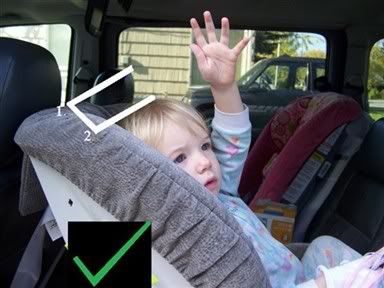
http://www.car-seat.org/showthread.php?t=30201
To determine if your child has outgrown his/her rear facing seat, you need to look from the side, not the front, top, or back.  Draw a line perpendicular to the shell/back of the car seat over the top of the child's head (#1). Then draw a second line out from the top of the shell/back, parallel to the first line (#2).  Now measure the distance between the two lines. When there is *less than one inch*, the rear facing restraint is outgrown by height.


After market products.  Don't use them.  This includes head rests/supports, the fuzzy things you put on the straps, seat protectors for your car; anything that didn't come with your seat.  Using these products could interfere with the function of your seat, not to mention void your warranty.  You'll notice that NONE of the products on the left are even made by car seat manufacturers.  These products have not been crash tested, and have not been proven safe.  It's better to just not sue them.  If you feel like the straps are digging into your child's neck, you can cut the toes off of an infant sock and slide it onto the harness to protect the neck.  But bulky puppy dogs that push the chest clip down to the belly are a no go for many reasons already stated.  Before you buy, check to make sure it's a safe product.


Secure your projectiles.  If your car has a trunk, you should probably just store everything in there.  But since SUVs and Minivans are more and more popular these days, it can be difficult for many people to secure potential projectiles.  Anything that is harder than a stuffed animal or blanket should be secured.  Toys given to children to play with should be soft and squishy.  Avoid giving sippy cups and bottles when the car is in motion.  The risk of projectiles seems obvious: velocity x mass = force.  A five pound purse moving at 30mph can be fatal, and even a small sippy cup can cause serious and traumatic injuries. Imagine that five pound purse hits your child.  Imagine that it hits your child in the face.  Secure your purse, gallons of milk, first aid kit, water bottle, etc.  Yeah, it's a pain in the butt, but it's important.  Also important to secure are your animals.  If you can't crate them in the car (safety option) then you can shop around for some animal friendly harness systems (they sell them at PETsMART).  Not only is it safest for your pet to not become a projectile, but it's safer for everyone in the car.
Wrong.  This adorable puppy can become a projectile.


Now that you're full of all kinds of information, here's a quick summation of some of the main points:
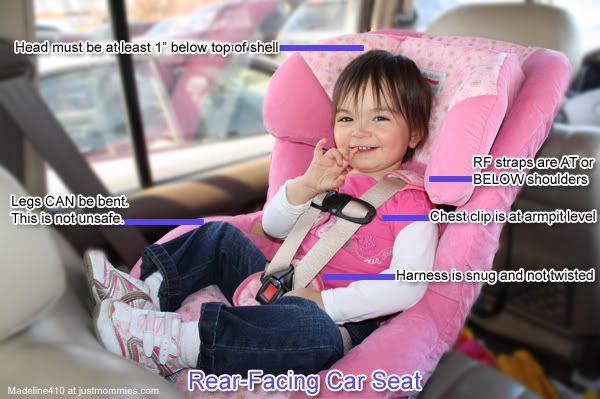
Photo courtesy of Madeline410 at Justmommies.com

Harness Good; Booster Bad

Okay, so booster seats obviously aren't a BAD thing, but lately I have seen SO many kids in booster seats that should still be in harnesses.  The minimum requirements of a booster requirement are as follows:

40 pounds
40in tall
4 years old

Almost four is NOT four. 

And truth be told, four is too young for a booster.  Why? Because a child in a booster seat needs to be able to control their impulses.  They need to be able to sit still.  They need to be able to not fall asleep.  They have to be old enough and mature enough to resist the urge to lean forward to get a toy, or especially to unbuckle their seat belt to get to something they can't reach otherwise.  They need to be able to NOT do all the things we do as adults.  Generally speaking, the minimum age that kids can do this is 6, sometimes 5.  Rarely four, and never three!

Reasons you may want to use a booster

I know it's convenient to use a booster seat.  There's no harness adjustment, the kid can buckle themselves in.  Getting in and out of the car is so much faster!  Trust me, I have to harness three kids under four (read: squirmy / sticky kids) in car seats every time I go somewhere.  I have to get them out of their harnesses when we get where we're going, and I have to put them back in when we're done.  This does in fact make quick errands a total pain in the butt.  I either suck it up or make my husband run those errands sans children (or make him watch the children while I do it myself).  Like all three year olds, mine is willful, defiant, and has an over-developed sense of independance.  Honestly, this just means he has all the more reason to stay in a harness!

And of course a booster seat a milestone that means out babies are growing up. *bitter sweet tear*  But just like every other growing up milestone, reaching it too early isn't a good thing.  Would you make your 6 month old learn to walk, or feed your 2 week old baby strained peas?  No, probably not, because you know they aren't ready for that kind of development.  Likewise, your 3-4 year old kid isn't ready for the kind of development it takes to sit safely in a booster seat, and you shouldn't make them.

Reasons you should use a booster

The ONLY reason to use a booster seat is that your child has outgrown his five-point harness by either height or weight.  Since the average, cheapest, forward facing car seat harnesses to 40 or 50 pounds, I find it hard to believe that an average three-year-old has outgrown it.  Some three-year-olds, yes - of course.  Every child is different.  But if that's the case, then the correct decision is to buy an expensive car seat.  I know it's tight on a lot of budgets, but being unsafe isn't a valid option.  Sorry, but it's not, and boostering a child that's too young for it is unsafe.

Examples of Booster Positioning

This is MY 3-year-old.  He is 43in tall, and he weighs 63 pounds.  I am hard pressed to find another 3-year-old that is as tall or as heavy as mine.  I'm sure they exist, I've just never met one.  Here is Luke in a booster seat.

The shoulder strap should be across the middle of his shoulder - in this picture it's too close to his neck.
The lap belt should be across his thighs, but in this picture it's across his soft belly, which encases his soft internal organs.  Do you think that the seat belt forces during a collision should hit him in the stomach?
This is NOT a good Booster seat fit at all.
Point I'm making: ff my enormous 3-year-old doesn't fit in a booster seat yet, then your average sized 3-year-old most definitely doesn't.  And proper fit is only the first requirement.

This is what a correct fit looks like:


Side by side for an easy comparison:


High back booster good; No/low back booster bad.
Again, not always bad, but bad if the child isn't ready.  A high back booster (like both pictures above) provides protection in the case of a side collision.  Instead of an outbound seated child's head hitting the window of the car, his head will hit the nicely padded, soft cushion that is part of his booster seat.  And if your child is belted in the middle position, then his head, neck, and spine have a much shorter distance to travel to one side before being stopped.  Why would you ever NOT give them that as long as possible? The only reason to use a low back booster is if the child has outgrown the back.

Reasons to stop using a booster seat
"I'm going to be laughed at" isn't sufficient.  While it is heartbreaking to think of our children being teased, and while instinct may tell us to prevent it at most costs, this is not one of the costs to risk.  Giving up the booster seat too early could mean the life of your child - they still need to be protected even if it's potentially embarrassing.  The only valid reason to take your child out of a booster seat is if the safety belt fits them better without one.

Don't believe be yet? Want some crash test videos? Here you go!

Side impact with a high back booster:

Backless versus high back:

Submarining: The motion of an occupant when one or both hips slide under the lap belt, so that the belt applies crash forces to the soft abdominal area between the pelvis and ribs


Last but not least, here's an ad from Britax for their booster seat.  All marketing aside, they have some informative drawings detailing the issues with booster seats if not used correctly.  And if your child is too small or not mature enough, the seat won't be used correctly.


 Had enough? Here's one more.  Meet Kyle.  He was in a booster seat, but the buckle on his seat belt failed.  Had he been harnessed and installed with the seat belt, it still would have failed, but he would have been tethered with the top anchor.  The seat would not have been ejected.  And if he wasn't tethered, the seat would have been ejected WITH him, as opposed to just Kyle being ejected.  It would have still provided a bit of protection, and while he would have been seriously injured, he may have survived.


 There are few decisions we can make as parents that come with guarantees of safety or happiness, but we still do the best we can.  Don't let a booster seat be a bad decision.

Car Seat Safety, thought out


The US law about turning a child around in the car is one year AND 20 pounds.  If someone tells you that "10 months is close enough" or "they weigh 20 pounds so it's fine" - they are wrong.  They are encouraging you to break the law.  Don't listen.

Your Pediatrician is not a Certified Car Seat Technician, or a Manuel
Pediatricians don't always know everything about keeping children safe.  Their job is to keep children healthy.  Their job is to treat illness, and prevent death from virus, bacteria, disease, infection, etc.  While sometimes they know what they are talking about, it's unfair to expect them to know everything.

If your child were to drink draino, would you call your pediatrician, or would you call poison control? If you think your child has a broken arm, do you take them to the eye doctor? While an eye doctor may be able to diagnose a broken arm, and while a pediatrician may know what to do in the case of draino indigestion, your instinct and experience tells you to pick the BEST source of information available to you.  Car seat safety shouldn't be any different.

Laws are not choices
A LOT of people will exceed a posted speed limit, because the penalty for doing so isn't very high.  Nevermind the added risk of speeding, nevermind the fact that speed limits aren't just arbitrary numbers picked by people in order to generate revenue.  Obviously they are a good way of generating revenue, but that's not the point.  If you'll notice, though - many will speed on a regular road, but few will speed through a school zone or an active construction zone.  Why? Because the penalty is higher in these areas - usually double.  People aren't willing to risk that.  Few actually consider that a child MAY run into the road, and going to posted speed limit will give you enough time to stop.  I'm sure it crosses minds at some point, but it's one of those "it'll never happen to me" kind of things.

Car seats LAWS exist for a reason.  They represent the bare minimum level of safety you can accomplish.  There is no law specifically about using the seat correctly, other than which direction it faces.  Most states have a law that says you must use the seat according to the manual, but if you're pulling over by police they don't care if the straps are tight enough or the chest clip is too low.  People will continue to ignore car seat laws until the penalty for breaking them is steeper.

Stop and Think About It
It's kind of sad really, how we as a society are inconsiderate of the lives of others, and even of our own children, when they get in the way of our own convenience.  Heaven forbid we take 60 seconds longer to arrive at work because we didn't want to risk the lives of ourselves or others on the road.  Heaven forbid we keep our children as safe as possible, even though they LOOK like they MIGHT BE uncomfortable (but probably aren't).

It also amazes me how many people take basic precautions in every other aspect of parenting.  We don't leave cleaning products where our toddlers can find them.  We don't let our toddlers play outside alone where we can't see them.  We don't let our toddlers go to the grocery store by themselves, or leave them home while we run to the market.  And yet we are content to risk injury to their internal organs, permanent paralysis, and even death because "they are happier when they can see me" and "it makes giving them snacks so much easier."  Doesn't really make much sense does it?

Car Seat Options for the Savvy Shopper


Because I've been shopping for a car seat (or two or three) for a couple of weeks now, I figured this was a good place to put all my thoughts down so I can review them any time I want.  Could I use a document and save it to my desk top? Yeah, but where's the fun in that?!  I also felt like a lot of lists I was finding online were out dated or incomplete.  I hear about the same handful of seats over and over, and I wanted to know all my options and not feel limited to only a few choices.
So here is a lovely list of car seats and options, in case you need to go shopping.

***I've included every brand I could think of, but I'm sure there are some missing.  If you see one missing, let me know.

***I've included what specs I could find on the seats, like height limits and top slot harness heights, but didn't check manuals or anything so I'm not 100% certain on some of them.  If you see something incorrect please let me know so I can correct it.  Thanks!

***I've divided the seats into categories:
Rear facing infant carriers
Convertible Seats
A section for all the seats that rear face to 40 pounds or more
Seats that harness for more than 40 pounds
Booster Seats

***I did not include seats that only forward face from 20-40 pounds, because I find them silly.

***Some seats will show up in more than one category (lots of convertibles have extended length harnesses), with the applicable specs listed for that section.

***Prices may vary.  Many of the prices listed are direct quotes from the website, but the seats can OFTEN be found much cheaper.  So if it's a little above your budget, shop around and you may find you can afford it.  For instance, the Graco Nautilus is listed at $180, but I paid $140 for mine, and I've seen them even lower.  I have put the seats in order by listed price though, to make it a little easier to choose that way.

*** Yes, I did spend five hours on this, and yes, you better appreciate it. =)

Infant Bucket Seats 
(the ones that detach from the base so you can carry them around)(seats are ordered by price, lowest to highest)
Evenflo Enbrace (22 pounds and 29in) - $55
Evenflo Discovery 5 (22 pounds and 29in- $60
Safety 1st Comfy Carry Elite Plus (22 pounds and 29in- $90
Evenflo Serenade (35 pounds and 32in- $100
Graco Snugride (22 pounds and 29in- $120
Graco Snugride 30 (30 pounds and 30in- $130
Safety 1st onBoard 35 (35 pounds and 32in- $140
Graco SnugRide 32 (32 pounds and 32in) - $150
Combi Shuttle (33 pounds and 33in- $150
The First Years Via Infant Seat 1470 (35 pounds and 30in- $160
Grago Snugride 35 (35 pounds and 32in- $160
Evenflo Secure Ride 35 (35 pounds and 32in- $170
Safety 1st onBoard 35 Air (35 pounds and 32in- $170
Chicco KeyFit (22 pounds- $170
Chicco KeyFit 30 (30 pounds- $180
Britax B-safe (30 pounds and 32in- $180
Safety 1st onBoard Air SE (35 pounds and 32in- $190
Peg-Perego Primo Viaggo (30 pounds and 30in- $220
Britax Chaperone (30 pounds and 32in- $230


Convertibles
(Rear face and forward face)(seats are ordered by price, lowest to highest)

Evenflo Tribute Sport (RF to 35 pounds and 36in, FF to 40 pounds and 40in)(shoulder height 14.75in) - $50
Cosco Scenera (RF to 35-40 pounds and 36in, FF to 40 pounds and 40in)(shoulder height 14.75in) - $50
Safety 1st onSide air (RF to 40p and 40in, FF to 40 pounds and 43in)(shoulder height 15in- $80
Evenflo Titan Sport (RF to 35p and 36in, FF to 50 pounds and 47in)(shoulder height 15in) - $80
Evenflo Tribute Deluxe (RF to 35 pounds and 36in, FF to 40 pounds and 40in) - $85
Graco ComfortSport (RF to 30 pounds, FF to 40 pounds and 40in)(shoulder height 13.5in- $100
Safety 1st Alpha Omega Elite (RF to 35 pounds, FF to 50 pounds- $100
Evenflo Titan Elite (RF to 35p and 36in, FF to 50 pounds and 47in)(shoulder height 15in- $100
Evenflo Triumph 65 (RF to 40 pounds, FF to 65 pounds and 47in)(shoulder height 17in)- $130
Evenflo Triumph Advance LX (RF to 35p and 36in, FF to 50p and 47in)(shoulder height 17in- $150
Evenflo Momentum (RF to 40 pounds, FF to 65 pounds and 50in- $150
Safety 1st All-in-One (RF to 35 pounds and 36in, FF to 50 pounds and 40in- $150
Graco MyRide 65 (RF to 40 pounds, FF to 65 pounds and 49in)(shoulder height 17in) - $150
Combi Coccoro (RF to 33 pounds, FF to 40 pounds and 40in)(shoulder height 15in) - $180
Safety 1st Complete Air 65 (RF to 40 pounds and 40in, FF to 65 pounds and 52in) - $190
Safety 1st Complete Air (50 pounds)- $190
Britax Roundabout 55 (RF to 40p, FF to 55 pounds and 46in)(shoulder height 15.75in) - $200
The First Years True Fit (RF to 35 pounds, FF to 65 pounds and 50in)(shoulder height 17.5in) - $200
Safety 1st Complete Air 65 LX (RF to 40 pounds and FF to 65 pounds and 52in- $210
Evenflo SymphonyE3 (RF to 40p and 36in, FF to 65 pounds and 47in)(shoulder height 16in) - $230
Sunshine Kids Radian65SL (RF to 40, FF to 65 pounds and 53in)(shoulder height 17in- $230
Recaro ProRide (RF to 35 pounds, FF to 70 pounds and 50in- $230
Safety 1st Complete Air 65SE (RF to 35, FF to 65 pounds and 52in)(shoulder height 17in) - $240
Combi Zeus 360 (RF to 33 pounds and 36in, FF to 40 pounds and 40in- $260-$400
Sunshine Kids Radian80SL (RF to 45, FF to 80 pounds and 53in)(shoulder height 17in- $270
Britax Marathon 70 (RF to 40 pounds ,FF to 70 pounds and 49in)(shoulder height 16.75in- $290
Peg-Perego Primo Viaggio SIP (RF to 35 pounds, FF to 70 pounds and 49in- $300
Sunshine Kids RadianXTSL (RF to 45, FF to 80 pounds and 53in)(shoulder height 17in- $300
Britax Boulevard 70 (RF to 40 pounds, FF to 70 pounds, and 49in)(shoulder height 16.75in- $320
Britax Boulevard 70 CS (RF to 40, FF to 70 pounds and 49in)(shoulder height 16.75in- $340
Britax Advocate 70 CS (RF to 40, FF to 70 pounds and 49in)(shoulder height 17.65in- $380


Seats that Rear Face to 40 pounds
(These will typically last the longest, assuming your child isn't exceptionally tall, and rear facing is always safer, so the longer the better)(Seats are ordered by height of shell, from smallest to largest)

Cosco Scenera (shell height of 23in)
Safety 1st onSide Air (shell height of 23in)
Graco My Ride 65 (shell height of 23in)
Evenflo Triumph 65 (shell height of 23.5in)
Britax Roundabout 55 (shell height of 23.5in)
Britax marathon 70 (shell height of 24in)
Britax Boulevard 70 (shell height of 24in)
Britax Advocate 70 CS (shell height of 24in)
Evenflo Momentum (shell height of 24.5in)
Sunshine Kids RadianXTSL (45 pounds)(shell height of 24.5in)
Sunshine Kids Radian65SL (shell height of 25in)
Sunshine Kids Radian80SL (45 pounds)(shell height of 25in)
Britax Boulevard 70 CS (shell height of 25in)
Evenflo Symphony e3 (shell height of 26in)
Safety 1st Complete Air 65 LX (shell height of 27.5in)
Safety 1st Complete Air (shell height of 27.5in)
Safety 1st Complete Air 65 (shell height of 27.5)


Extended Harnessing
(Kids should stay harnessed until they can safely be boostered, and sometimes that means they won't be ready at 40 pounds.)(seats in order by height of top harness slot, when known, from lowest to highest)
Evenflo Titan Sport (50 pounds and 47in)(shoulder height 15in- $80
Evenflo Generations (65 pounds and 43in)(shoulder height 15in) - $100
Safety 1st Alpha Omega Elite (50 pounds) (shoulder height 15in) - $100
Evenflo Titan Elite (50 pounds and 47in)(shoulder height 15in)- $100
Safety 1st All-in-One (50 pounds)(shoulder height 15in- $150
Britax Roundabout 55 (55 pounds and 46in)(shoulder height 15.75in) - $200
Britax Marathon (65 pounds and 49in)(shoulder height 16in- $200
Evenflo Symphony 65 DLX (65 pounds and 47in)(shoulder height 16in- $200
Evenflo Symphony 65 e3 - (65 pounds and 47in)(shoulder height 16in) - $230
Britax Roundabout 50 (50 pounds and 49in)(shoulder height 16.25in) - $160
Britax Marathon 70 (70 pounds and 49in)(shoulder height 16.75in- $290
Britax Boulevard 70 (70 pounds, and 49in)(shoulder height 16.75in) - $320
Britax Boulevard 70 CS (70 pounds and 49in)(shoulder height 16.75in) - $340
Evenflo Triumph 65 (65 pounds and 47in)(shoulder height 17in)- $130
Graco MyRide 65 (65 pounds and 49in)(shoulder height 17in- $150
Evenflo Momentum 65 (65 pounds and 50in)(shoulder height 17in- $150
Evenflo Triumph Advance LX (50 pounds and 47in)(shoulder height 17in)- $150
Safety 1st Complete Air 65 (65 pounds and 52in)(shoulder height 17in- $190
Safety 1st Complete Air 65 LX (65 pounds and 52in)(shoulder height 17in) - $210
Safety 1st Complete Air 65 SE (65 pounds and 52in)(shoulder height 17in- $240
Safety 1st Complete Air (50 pounds and 45in)(shoulder height 17in- $190
Sunshine Kids RadianXTSL (80 pounds and 53in)(shoulder height 17in) - $300
The First Years True Fit (65 pounds and 50in)(shoulder height 17.5in- $200
Sunshine Kids Radian65SL (65 pounds and 53in)(shoulder height 17in- $230
Sunshine Kids Radian80SL (80 pounds and 53in)(shoulder height 17in- $270
Britax Adcovate 70 CS (70 pounds and 49in)(shoulder height 17.5in) - $380
Evenflo Maestro (50 pounds and 47in)(shoulder height 18in- $85
Recaro ProSport (90 pounds and 57in)(shoulder height 18in) - $200-$300
Graco Nautilus (65 pounds)(shoulder height 18.5in- $180
Britax Frontier 85 (85 pounds and 57in)(shoulder height 20in) - $300
Britax Frontier 85 SICT (85 pounds and 57in)(shoulder height 20in) - $340

Safety 1st Apex 65 (65 pounds and 57in- $130
Safety 1st Essential Air (65 pounds- $180
Safety 1st Go Hybrid (65 pounds- $200
Peg-Perego Primo Viaggio SIP (70 pounds and 49in- $220
Recaro ProRide (70 pounds and 50in- $230


Booster Options
(a booster seat lacks a harness and requires the car's safety belt.  For info on when to transition to a booster seat see my post called Harness Good; Booster Bad)(seats ordered by price, lowest to highest)
Cosco Pronto (30-100 pounds and 34-57in- $35
Graco Highback Turbo Booster (30-100 pounds- $50
Evenflo Big Kid Deluxe (40-100 pounds- $50
Cosco HBB (30-80 pounds- $55
Safety 1st Boost Air (30-100 pounds)- $66
Graco Highback Turbobooster Elite (30-100 pounds) - $70
The First Years Compass B505 (30-100 pounds and 38-57in) - $70
Sunshine Kids Santa Fe NBB (30-120 pounds) - $70
Evenflo Maestro (40-100 pounds) - $80
Safety 1st Vantage HBB - $90
Eddie Bauer HBB (40-100 pounds) - $90
Evenflo Generations (40-100 pounds) - $100
Safety 1st Summit Deluxe HBB - $110
Britax Parkway SG (40-120 pounds and 38-63in)(shoulder height 21.5in) - $120
Safety 1st Apex 65 (40-100 pounds)- $135
Britax Parkway SGL (40-120 pounds and 38-63in)(shoulder height 21.5in) - $150
Sunshine Kids Monteray HBB (30-120 pounds and 63in) - $150
Chicco KeyFit Strada Booster (33-100 pounds and 38-57in) - $170
Safety 1st Essential Air (40-100 pounds and 57in)- $180
Graco Nautilus (30-100 pounds) - $180
Safety 1stt Go Hybrid - $200
Recaro ProSport (up to 100 pounds) - $200-$300
Evenflo Symphony 65 e3 (40-100 pounds) - $230
Britax Frontier 85 (40-120 pounds and 42-65in)(shoulder height 24.5in) - $300
Britax Frontier 85 SICT (40-120 pounds and 42-65in)(shoulder height 24.5in) - $340
The First Years Compass B830 (30-100 pounds and 57in) - ?
Recaro Vivo HBB (30-100 pounds) - $90